
DJI Mavic 4 Pro vs. Air 3S: Which Professional Drone Is Right for You?
Both the DJI Mavic 4 Pro and DJI Air 3S are serious drones for serious creators. Both feature large-sensor camera systems, with Air 3S built around a 1-inch main camera and Mavic 4 Pro built around a 4/3-inch Hasselblad main camera. But they're positioned at very different points in the lineup — and the gap between them is more meaningful than the spec sheet might suggest. Here's a clear breakdown.
The Short Answer
If you shoot travel content, landscapes, or portraits and want a versatile, portable drone that handles almost anything, the Air 3S is the right choice. If you shoot commercially, need the absolute best image quality, or want a triple-camera system with cinematic gimbal flexibility, the Mavic 4 Pro is the professional tool you're looking for.
At a Glance
|
DJI Air 3S |
DJI Mavic 4 Pro |
|
|
Main sensor |
1-inch CMOS, 50MP |
4/3 CMOS Hasselblad, 100MP |
|
Main camera video |
4K/60fps HDR, 4K/120fps (Slow Motion) |
6K/60fps HDR |
|
Dynamic range |
14 stops |
15.5 stops |
|
Camera system |
Dual (wide + 70mm tele) |
Triple (wide + 70mm tele + 168mm tele) |
|
Tele cameras |
1/1.3-inch, 48MP |
1/1.3-inch (70mm) + 1/1.5-inch (168mm) |
|
Gimbal |
Standard 3-axis |
Infinity Gimbal, 360° rotation, 70° upward |
|
Obstacle sensing |
Nightscape omni (1 lux) |
Nightscape omni (0.1 lux) |
|
Flight time |
45 min |
51 min |
|
Transmission |
O4, 20km |
O4+, 30km |
|
FAA registration |
Required |
Required |
The Camera System
This is the biggest difference between the two drones.
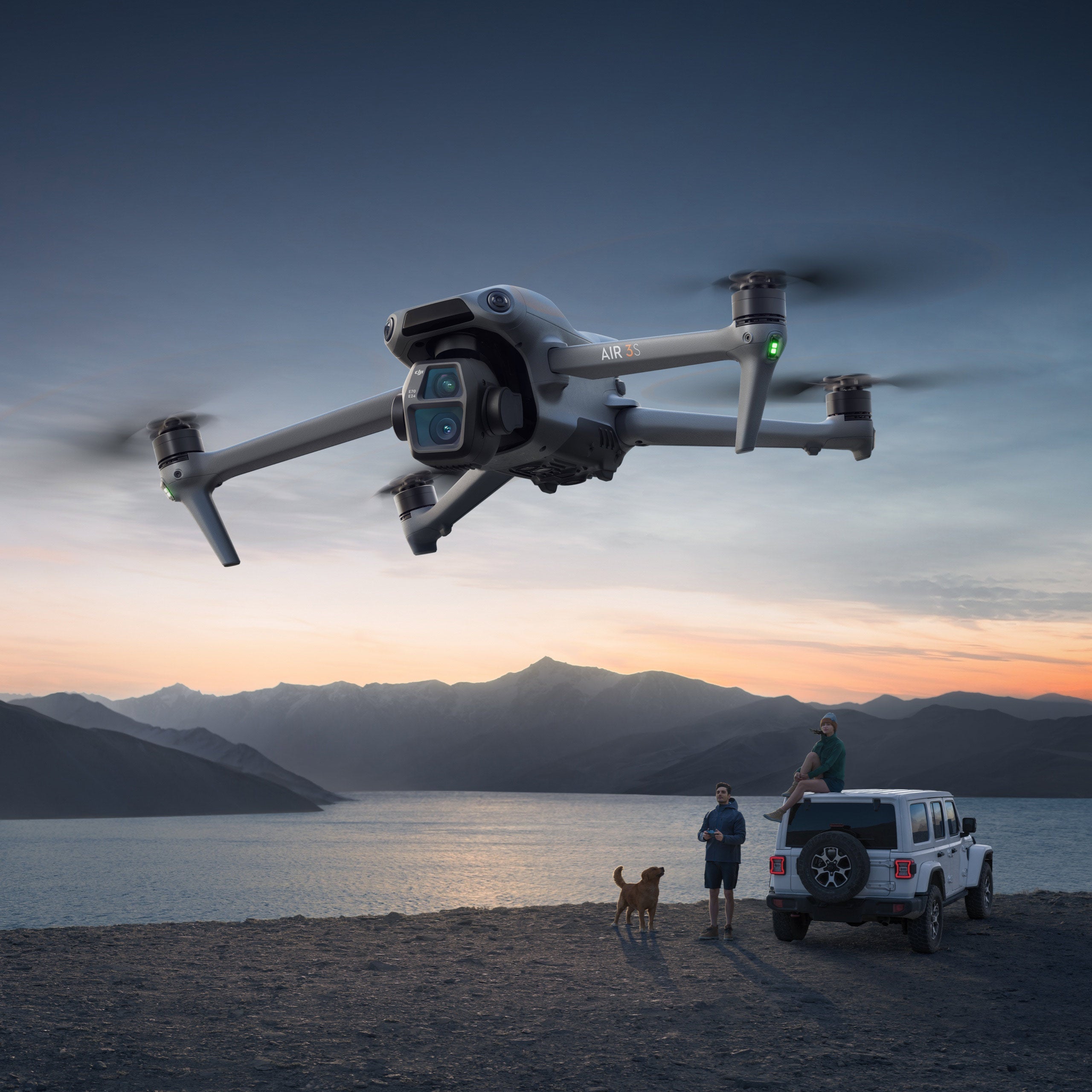
The Air 3S is a dual-camera drone — a 1-inch primary wide-angle camera and a 70mm medium tele camera. Both shoot 4K/60fps HDR and share the same color modes. It's a highly capable two-focal-length system that covers the vast majority of aerial photography scenarios.
The Mavic 4 Pro is a triple-camera drone — a 4/3-inch Hasselblad wide-angle camera, a 70mm medium tele, and a 168mm tele camera. The main camera shoots 6K/60fps HDR with 15.5 stops of dynamic range and 100MP photos. The 168mm tele camera upgrades to a 1/1.5-inch sensor for enhanced image quality at long range. This is DJI's most advanced consumer imaging system.
For most creators, the Air 3S's dual-camera setup is more than capable. But for commercial productions, wildlife photography, or work where you need the reach of a 168mm lens and the richness of a 6K Hasselblad sensor, the Mavic 4 Pro is in a different class.
The Infinity Gimbal
One of the Mavic 4 Pro's most distinctive features is its Infinity Gimbal — a gimbal that supports full 360° rotation and 70° upward shooting. This opens up camera angles that a standard gimbal simply can't achieve: overhead shots, rotating transitions, and perspectives that previously required specialized rigs.
The Air 3S has a standard 3-axis gimbal. It's excellent — smooth, reliable, and capable of vertical shooting. But it doesn't offer the same creative range.
Obstacle Sensing at Night
Both drones have Nightscape omnidirectional obstacle sensing, but the threshold is different:
- Air 3S — works in lighting conditions exceeding 1 lux
- Mavic 4 Pro — works in lighting conditions exceeding 0.1 lux
In practice, the Mavic 4 Pro's obstacle sensing operates in significantly darker environments — useful for nightscape photography in urban settings or other low-light scenarios where even 1 lux can be hard to guarantee.
Flight Time and Transmission
The Mavic 4 Pro offers 51 minutes of flight time versus 45 minutes for the Air 3S — a meaningful difference for long shooting sessions. Transmission also steps up from O4 (20km) on the Air 3S to O4+ (30km) on the Mavic 4 Pro, with stronger signal stability and enhanced anti-interference capabilities.
Size and Portability
The Air 3S is the more portable drone. It's compact enough for travel bags and easier to carry on longer shoots. The Mavic 4 Pro is larger and heavier — a trade-off that comes with its more advanced camera system and longer flight time.
Who Should Buy the Air 3S
- You shoot travel, landscape, and portrait content and want a versatile dual-camera setup
- Portability matters — you're carrying the drone on trips or hikes
- You want excellent performance at a more accessible price point
- The Air 3S's 1-inch sensor and dual cameras cover everything you need
Who Should Buy the Mavic 4 Pro
- You shoot commercially or need the highest image quality available
- You need a triple-camera system with a 168mm tele lens
- You want the Infinity Gimbal for dynamic, creative camera movement
- You fly at night and need obstacle sensing to work in near-dark conditions
- Flight time and transmission range are critical for your productions

The Verdict
The DJI Air 3S is the drone for ambitious creators who want professional-grade results without the size and cost of a flagship system. The DJI Mavic 4 Pro is for professionals who need the best — a triple-camera Hasselblad system, the Infinity Gimbal, and the most advanced obstacle sensing DJI offers in a consumer drone.
Browse the full DJI drone collection at DJI USA, with fast US shipping, 30-day returns, and a 1-year warranty on every model.